Overview
Case type: Director’s Loan Account & Misfeasance Claim
Industry: Recruitment
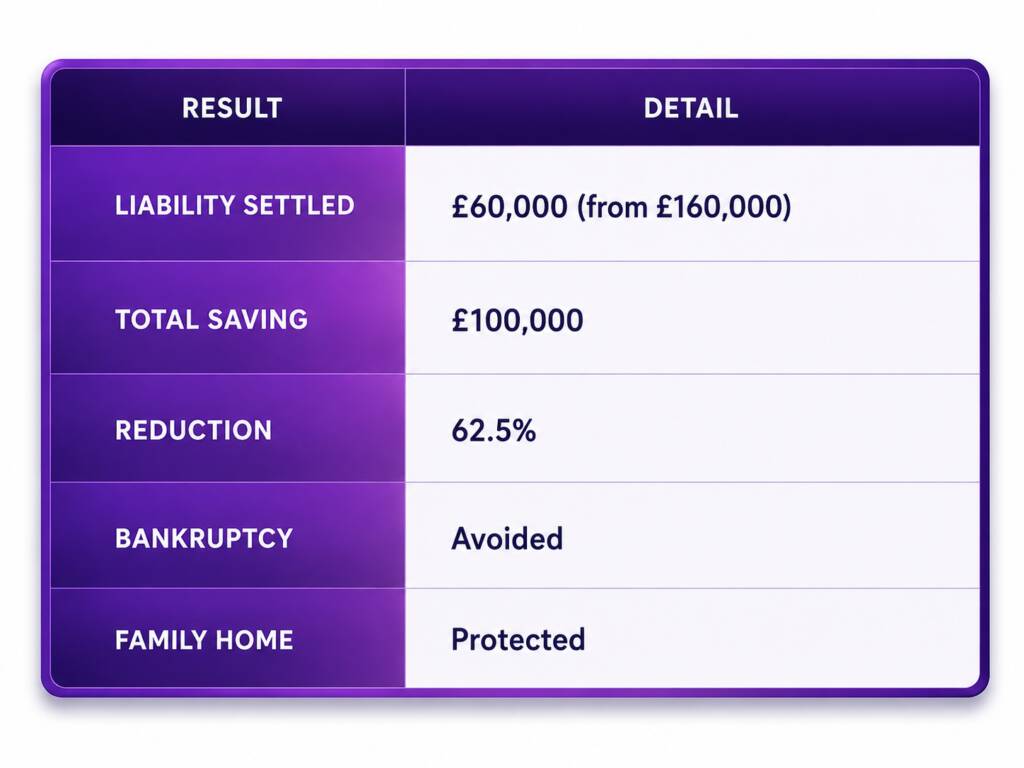
Original Liability: £160,000
Settlement Achieved: £60,000
Total Saving: £100,000
Key Threat Avoided: Bankruptcy and loss of family home
Outcome: Full and final settlement negotiated
If you are facing a director’s loan claim, a misfeasance allegation, or the threat of bankruptcy, early action is the most effective way to protect your personal assets.
When a Company Collapse Follows You Home
A liability on paper can quickly become a burden that follows you home. For our client, a director working in the recruitment sector, that reality became starkly apparent when the company he was involved with entered liquidation. The collapse left in its wake a substantial Overdrawn Director’s Loan Account (DLA) and a misfeasance claim, both of which were being actively pursued by a major commercial law firm instructed by the appointed insolvency practitioners.
What made the situation particularly difficult was that our client had not been involved in the day-to-day management of the business and had no clear understanding of how the claim against him had been calculated.
With a total liability of £160,000 hanging over him and over £70,000 of equity in his family home at risk, the stakes could not have been higher. Without intervention, bankruptcy was a very real possibility, and with it, the loss of everything his family had built.
Our client’s overriding priorities were straightforward: protect his home and avoid bankruptcy.
But achieving those objectives required more than generic debt advice. He needed a team that would engage directly with the liquidator and their legal representatives, challenge the technical basis of the claim, and negotiate a resolution that made the threat of formal insolvency proceedings a commercially unattractive proposition for the other side.
An insolvency practitioner has statutory duties that prioritise recovering funds for creditors, not protecting the personal assets of the director they are pursuing. Our client needed an independent strategist firmly on his side. That is what brought him to Bell & Company.
The Challenges: Equity, Liability, and a Claim He Had Not Caused
This Bell & Company case study illustrates several compounding pressures our client faced simultaneously:
- A claim he did not understand: Our client had not been responsible for the day-to-day running of the business. The misfeasance claim was complex, and the basis on which the liability had been calculated was entirely opaque to him.
- Significant equity exposure: With more than £70,000 of equity in his property, the family home was firmly within the liquidator’s sights. In bankruptcy, that equity would almost certainly have been realised.
- The bankruptcy threat: Without a negotiated resolution, bankruptcy was the credible worst-case outcome. One that would have devastating long-term consequences for our client and his family.
- Professionally resourced opponents: The liquidator had instructed a major commercial law firm alongside an experienced insolvency practice. Our client was facing a professionally resourced pursuit of his personal assets. s a highly personal and difficult period.
The Bell & Company Strategy
We don’t follow a formula. We build a specific debt strategy around our client’s personal priorities. In this case, every element of our approach was designed with one objective: keep our client out of bankruptcy and protect his family home.
1. Direct Engagement with the Liquidator’s Legal Team
Rather than waiting for matters to escalate, we engaged directly and immediately with the commercial law firm instructed by the appointed insolvency practitioners to open a dialogue around settlement. Early engagement signals credibility and intent; it also buys time and changes the dynamic of the process.
2. Technical Challenge of the Claim
Given that our client had not been involved in the day-to-day management of the business, there were legitimate grounds to contest the claim from a technical standpoint. We worked to identify and articulate those grounds clearly, challenging both the quantum of the liability and the basis on which the misfeasance allegation had been constructed.
3. A Detailed Statement of Affairs and Commercial Comparison
We produced a comprehensive statement of affairs for our client, setting out his financial position in full. Crucially, we then presented a side-by-side comparison between what the liquidator could realistically expect to recover through formal bankruptcy proceedings – including the costs, delays, and uncertainties of that route – versus the certainty and speed of an informal settlement.
The property equity was central to this analysis. We undertook significant work on the valuation of the home to ensure the picture presented was accurate and defensible – accentuating the greater and more reliable recovery achievable through settlement, rather than the uncertain litigation path.
The Outcome
The strategy worked. Bell & Company successfully negotiated a full and final settlement of £60,000 against an original liability of £160,000; a saving of £100,000 and a 62.5% reduction on the original claim.
Most importantly, our client avoided bankruptcy. His family’s home – and the £70,000+ of equity within it – was protected. Upon conclusion of the matter, our client described the outcome as follows:
“I’m really pleased. It’s been a massive weight off my mind.”
Directors’ Loan Claims and Misfeasance: A Growing Risk
As UK insolvency levels remain persistently elevated, Overdrawn Director’s Loan Accounts and misfeasance claims are becoming an increasingly common feature of the post-liquidation landscape. Liquidators have both the incentive and the statutory obligation to pursue these claims vigorously, and they are typically supported by specialist legal teams experienced in doing so.
For directors – particularly those who were not involved in the day-to-day management of a failed business – these claims can feel deeply unjust. They can also be challengeable. The key is having an independent strategist on your side with the technical capability to identify weaknesses in the claim, the commercial credibility to negotiate a realistic settlement, and the experience to present the bankruptcy comparison in a way that makes informal resolution the rational choice for the other party.
This Bell & Company case study demonstrates exactly that capability in action.
Facing a Similar Situation? Hope Is Not a Strategy. Early Action Is.
If you are facing a misfeasance claim, or the threat of bankruptcy and are concerned about protecting your home and personal assets, contact Bell & Company today for a free, confidential case review. We work for you, not your creditors.
Disclaimer: This article is provided for informational purposes only and does not constitute formal legal, financial, or regulatory advice. You should always seek professional advice tailored to your specific circumstances before taking action.