When a company enters liquidation, many directors believe the worst is behind them once the doors close. For one skilled electrician who had spent years building his trade, the real nightmare began a full year after his company was wound up.
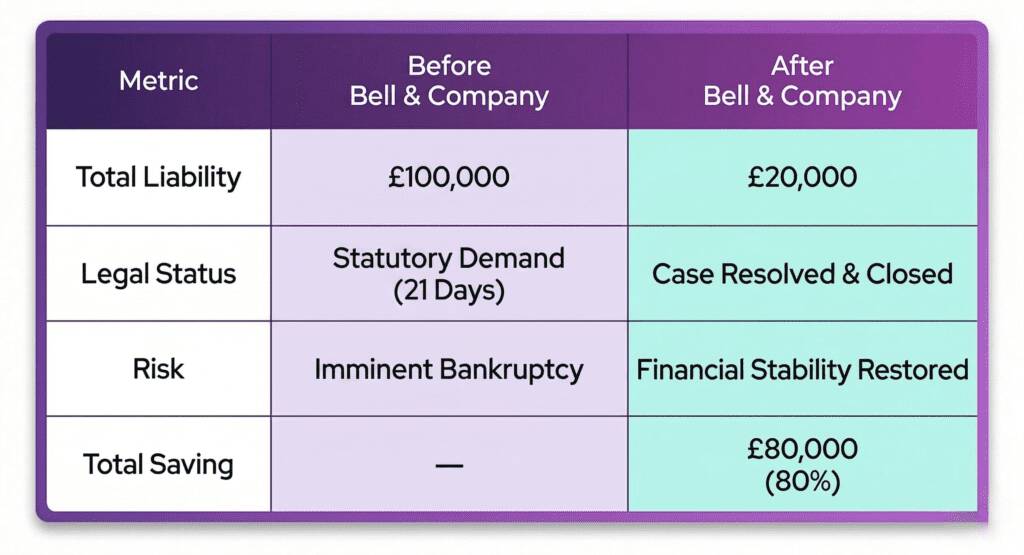
Out of nowhere, he was served with a Statutory Demand for £100,000. The claim, centred on an Overdrawn Director’s Loan Account (ODLA), threatened not just his new business venture, but his entire family’s financial stability. With only 21 days to respond before bankruptcy proceedings could begin, he turned to Bell & Company.
A Tradesman Rebuilding His Future
Our client is a dedicated electrician. A professional who had recently restarted a new business to support his family. While his previous Ltd company had entered liquidation in 2025, he believed he had followed the correct procedures.
His wife had previously served as a co-director, handling the invoicing and administrative side of the business, but had resigned prior to the liquidation. While their family home was held in her name – having been purchased independently before their marriage – the threat of personal bankruptcy loomed like a dark cloud over the household. Crucially, the client had been carrying the weight of this legal threat alone, shielding his wife from the stress of the Statutory Demand.
When a “Small Debt” Balloons
The catalyst for the crisis was a claim from the liquidators appointed to his former company. The dispute centred on an Overdrawn Director’s Loan Account (ODLA).
- The Shock Factor: The client initially recognised a relatively small ODLA of approximately £15,000.
- The Escalation: By the time liquidator fees, interest, and forensic charges were applied, the claim had ballooned to a staggering £100,000.
- The Trigger: A formal Statutory Demand was issued, giving him just three weeks to pay in full or face a bankruptcy petition.
“I couldn’t see where that would come from, where they got that figure from… I don’t know,” the client told us. He felt blindsided, powerless, and trapped by a figure that seemed to have no basis in reality.
The Existential Threat of Bankruptcy
For this director, this wasn’t just about the money; it was about survival. Bankruptcy would have had catastrophic consequences:
- Professional Ruin: As an electrician running a new business, bankruptcy would severely limit his ability to trade, hold credit, or manage a company.
- Family Impact: The fear of losing the financial security he had worked so hard to rebuild for his wife and children was overwhelming.
- The Deadline: When he contacted Bell & Company, 12 days of his 21-day window had already lapsed. Time was running out.
Our Strategy: Evidence, Expertise, and Negotiation
To challenge a firm as forensic as his liquidator, we knew a simple “request for leniency” wouldn’t suffice. We needed to demonstrate the commercial reality of the situation through a multi-layered strategy.
1. Financial Position Assessment & Witness Statement
We conducted a deep dive into the client’s personal finances. We established that he had a minimal net worth and few realisable assets. We prepared documentation to substantiate this, proving to the liquidator that even if they pursued bankruptcy, the “pot” for creditors was effectively empty.
2. Technical ODLA Reconciliation
Our team didn’t take the £100,000 figure at face value. We forensically analysed the director’s loan ledger, identifying inaccuracies and overstatements. By challenging the validity of the debt itself, we lowered the “ceiling” of the claim.
3. Commercial Negotiation
We presented a dual-track argument to the liquidator:
- Recoverability: Pursuing a man with no assets into bankruptcy would yield nothing for the creditors but more costs for the liquidator.
- Settlement Value: A fast, guaranteed settlement was a far more “commercially sensible” outcome for the liquidation estate.
The Challenges
The liquidators took a very forensic approach. They required extensive evidence and pushed back on our assessment of the client’s assets. It took a month of persistent, professional negotiation and a robust presentation of the facts to highlight that our proposed settlement was the best outcome they could hope to achieve.
The Outcome: An 80% Reduction
After intense negotiations, Bell & Company secured a full and final settlement for our client.
A New Lease on Life
The client was delighted with the result, noting that the outcome far exceeded his expectations. By settling for £20,000 – a figure he could realistically manage – he avoided the perceived stigma and restrictions of bankruptcy. He is now back to focusing on his trade and his family, without the shadow of a £100,000 debt hanging over him.
“A brilliant outcome that exceeded expectations.”
Key Takeaways for Directors
- Don’t Accept Figures as Final: Fees and interest can often double or triple the original debt. These can and should be challenged.
- Act Within the 21-Day Window: If you receive a Statutory Demand, every day counts. Early intervention is the key to preventing bankruptcy.
- Commerciality is Your Best Tool: Liquidators are driven by recovery. If you can prove that bankruptcy will yield them nothing, they are often willing to negotiate a realistic settlement.