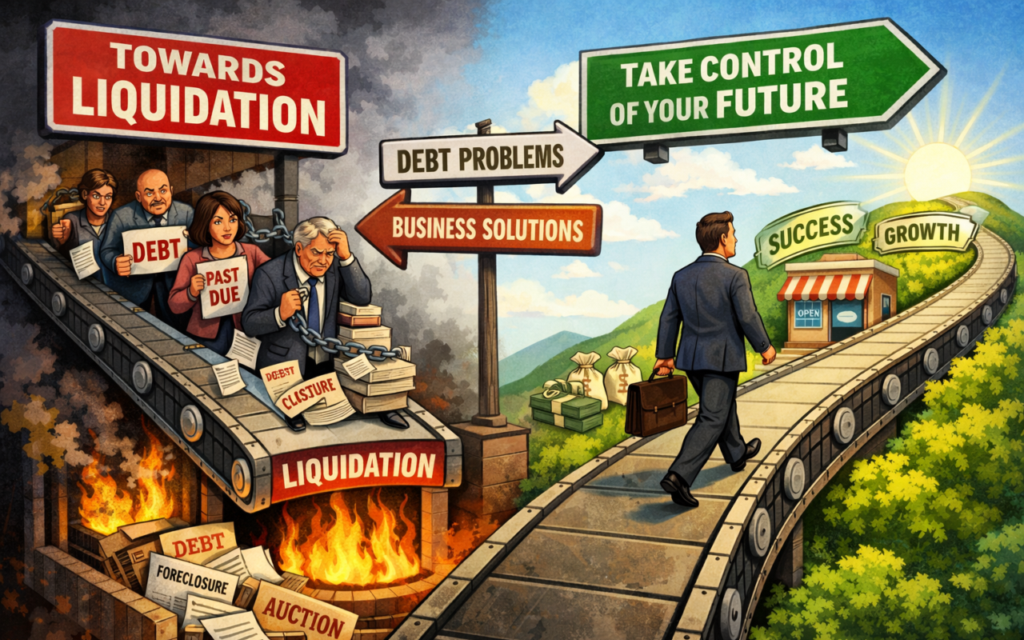
According to the Office for Budget Responsibility (OBR), the UK economy is beginning to show early signs of recovery. However, behind these headline figures lies a far more fragile picture. Business insolvency data reveals a growing and troubling divide, driven by tougher creditor action and sustained pressure on already-tight margins.
Our latest review, conducted by Bell & Company’s specialist debt strategy team, of CreditSafe data comparing November 2024 to November 2025, reveals a marked escalation in formal insolvency activity. The findings are unambiguous: corporate distress is accelerating, driven primarily by assertive tax-collection measures and underlying structural weaknesses across key sectors of the economy.
CreditSafe Analysis: A Growing Wave of Compulsory Liquidations
Our review of the latest CreditSafe data shows that the most severe pressure points now sit squarely within compulsory enforcement activity, particularly Winding Up Petitions (WUPs) and higher-value insolvency cases. The pattern is clear: the market has shifted from voluntary wind-downs to an environment increasingly dominated by forced liquidation and the collapse of larger, more complex entities.
Winding Up Petitions: An Unprecedented Surge
The most striking insight from November 2025 is the extraordinary escalation in Winding Up Petitions. Total WUPs rose by 92% year-on-year, with HMRC-initiated actions increasing by 124%, jumping from 198 to 287 cases. This confirms what many distressed firms already know: pandemic-era leniency has ended. HMRC is aggressively collecting arrears, and the impact is rippling across the economy.
A Broadening Creditor Base & Escalating Systemic Pressure
While HMRC remains the dominant petitioner – responsible for 75% of all WUPs – the enforcement environment has expanded far beyond the traditional sphere of financial institutions and trade creditors. CreditSafe data indicates growing activity from:
- Local councils
- Energy companies
- Private individuals
This diversification of enforcement signals a fundamental shift in how creditors are responding to cash flow stress. It reflects not only deepening financial strain across the economy but also the increasing urgency of creditors at every level, public, private, and individual, to recover overdue balances.
The Emerging Picture
Taken together, these trends reveal a systemic liquidity crisis in which a widening mix of creditors is resorting to the most severe enforcement tool available. For many businesses, this represents the final stage of financial deterioration – and for the wider economy, it underscores a sharp and accelerating escalation in corporate distress.
Concentration of Risk: The Rising Severity of Directors’ Debt
Beyond the surge in Winding Up Petitions, the latest figures reveal a critical shift in the distress landscape: while the sheer volume of high-value insolvency events like Administrations and Directors’ Loan Accounts (DLAs) is decreasing, the severity of the remaining DLA cases has dramatically intensified.
This suggests a deepening crisis for a smaller, highly exposed group of directors. The overall profile of distress is now characterised not by broad failure, but by a dangerous concentration of large, personal debt exposure, alongside an encouraging rise in formal restructuring attempts.
Directors Loan Accounts
The number of companies facing issues with Directors’ Loan Accounts (DLAs) decreased by 15%, falling from 120 cases in November 2024 to 102 cases in November 2025.
However, the financial risk associated with these accounts has intensified:
- The proportion of Overdrawn Directors’ Loan Accounts (ODLA) valued at greater than £50,000 increased from 43% in November 2024 to 50% in November 2025.
- Furthermore, in November 2025, 25% of the recorded ODLA cases were valued at greater than £100,000.
This pattern suggests that while fewer directors are relying on DLAs as a short-term measure, those who are have significantly larger amounts outstanding. This concentrates and magnifies the personal financial exposure and subsequent risk to directors once a company enters insolvency, frequently resulting in direct claims against them.
While formal failures of larger firms have moderated, the underlying economic pressure is compelling more businesses to seek formal restructuring and is concentrating personal financial risk.
- Administration appointments for mid-sized and larger firms fell by 21% (192 to 151)
- Receiverships saw a 100% decrease (9 to 0)
- This moderation in high-value failures is counterbalanced by a 46% increase in Company Voluntary Arrangements (CVAs) (13 to 19)
This indicates that directors are actively seeking rescue routes rather than closure. Even the Construction sector, often hit hardest, saw a 26% decrease in liquidations (301 to 224).
However, these shifts don’t signal a strong economic recovery; instead, they point to a change in how companies are managing persistent pressure. The drop in high-value failures may reflect a lag in creditor action or a shift towards informal debt management, while the rise in CVAs confirms that firms remain deeply troubled and require formal intervention to survive. This push towards restructuring over outright failure is a desperate attempt to preserve value in an economy where margins are tight, and debt serviceability remains a primary concern for directors across all sectors.
The Economic Backdrop: The Mixed Signals
The economic figures released in November 2025 present a mixed picture. There’s cautious optimism for overall growth, but businesses still face strong, structural cost pressures.
The Office for Budget Responsibility (OBR) is more optimistic, upgrading its 2025 real GDP growth forecast to 1.5% due to better-than-expected output in late 2024 and early 2025. Meanwhile, The Bank of England provided some monetary relief by holding the Base Rate at 4.0% in November 2025. This stability follows sustained easing since the August 2024 peak (5.25%), offering a welcome, though partial, reduction in borrowing costs.
Despite the Bank Rate cuts, CPI inflation remains stubbornly high at 3.6% (October 2025), still above the 2% target. Businesses are also struggling with significantly higher labour costs. This is driven by mandated increases to the National Living Wage (NLW) and higher employer National Insurance contributions (NICs), which are actively shrinking operating margins. Additionally, the wider economic cooling is evident in the job market, as the unemployment rate rose to 5.0% in Q3 2025, signalling increased job market slack.
The Underlying ‘Why’: Structural Fragility
Why are businesses failing at this pace when the official figures are painting a picture of growth? The “Growth-vs-Reality Paradox” is the key.
While the headline GDP figure suggests strength, the underlying structural issue facing UK businesses is far more concerning. The OBR simultaneously revised down its long-term productivity forecast due to historical underperformance. This crucial Productivity Reality Check underscores the deep-seated challenge facing the UK economy; the OBR noted that this downgrade alone reduces potential government revenue by a staggering £16 billion by 2029-30. This paradox explains why, despite a seemingly better short-term economic level, so many firms are failing: the structural weakness of low productivity and the subsequent low rate of return on capital means businesses cannot generate enough real income to absorb rising costs, driving the surge in insolvencies.
The Tax Squeeze and Enforcement Drive
The Government’s overriding commitment to fiscal tightening is the motivational context behind the high-tax pressure and aggressive enforcement driving the surge in insolvencies. To achieve this, a key measure is intensifying action to close the tax gap, aiming to raise an additional £10 billion by 2029-30 through enhanced compliance and pursuing rule-breakers. This commitment provides the direct political instruction for HMRC’s aggressive enforcement drive, explaining the massive surge in Winding Up Petitions highlighted in the recent data.
Monetary Policy and Weakening Demand
While the Bank of England’s decision to maintain the Base Rate at 4% suggests monetary policy has stabilised, the impact on businesses remains severe, primarily due to subdued demand. Monetary easing is being enabled by weak underlying economic growth and increasing caution from households, leading to a relentless profit squeeze.
The Monetary Policy Committee (MPC) specifically highlighted the risk of a “sharper rise in unemployment” driven by the “weaker cash positions of Small and Medium-sized Enterprises (SMEs)” that are buckling under higher employment costs. This confirms that the high-cost operating environment is directly fuelling SME failures and job losses, validating the alarming surge in insolvencies seen in the CreditSafe data.
The Verdict: State-Forced Failure
The CreditSafe figures for November 2025 do not represent a statistical outlier – they reflect the convergence of deliberate fiscal tightening with long-standing structural weaknesses in UK business profitability and productivity. The data makes it clear: businesses are not simply winding down in response to market pressures; many are being actively pushed into insolvency through intensified state enforcement. Crucially, this dynamic is also magnifying the personal liability for directors, evidenced by the soaring average value of Directors’ Loan Accounts in failing firms.
In an environment where headline GDP suggests recovery, the underlying picture tells a very different story. Corporate financial health is deteriorating at pace, with forced liquidations rising sharply and larger, asset-rich firms increasingly caught in the crossfire. The result is a growing disconnect between macroeconomic indicators and the day-to-day realities facing UK businesses, a divide that poses significant risks for directors, stakeholders, and the wider economy.
The message from the November 2025 data is clear: doing nothing is no longer an option. With HMRC aggressively pursuing tax arrears and the value of Directors’ Loan Account issues soaring, the risk of personal liability and forced liquidation has never been higher.
Bell & Company specialises in providing immediate, expert guidance to directors facing acute financial distress.
- Stop HMRC Action: We intervene directly with creditors, including HMRC, to halt Winding Up Petitions and negotiate realistic, structured repayment plans.
- Manage Personal Risk (DLAs): We provide strategic advice to ring-fence personal assets and navigate potential breaches of duty, protecting you from personal liability relating to Director’s Loan Accounts.
- Explore Viable Restructuring: Whether it’s a Company Voluntary Arrangement (CVA) to save a viable business or an orderly liquidation, we provide the best path forward to discharge liabilities and give you a clean slate.
Don’t wait until enforcement action is at your door. If you are struggling with tax debt, high overheads, or the threat of a WUP, take control today.
Contact Bell & Company for a confidential, free consultation.