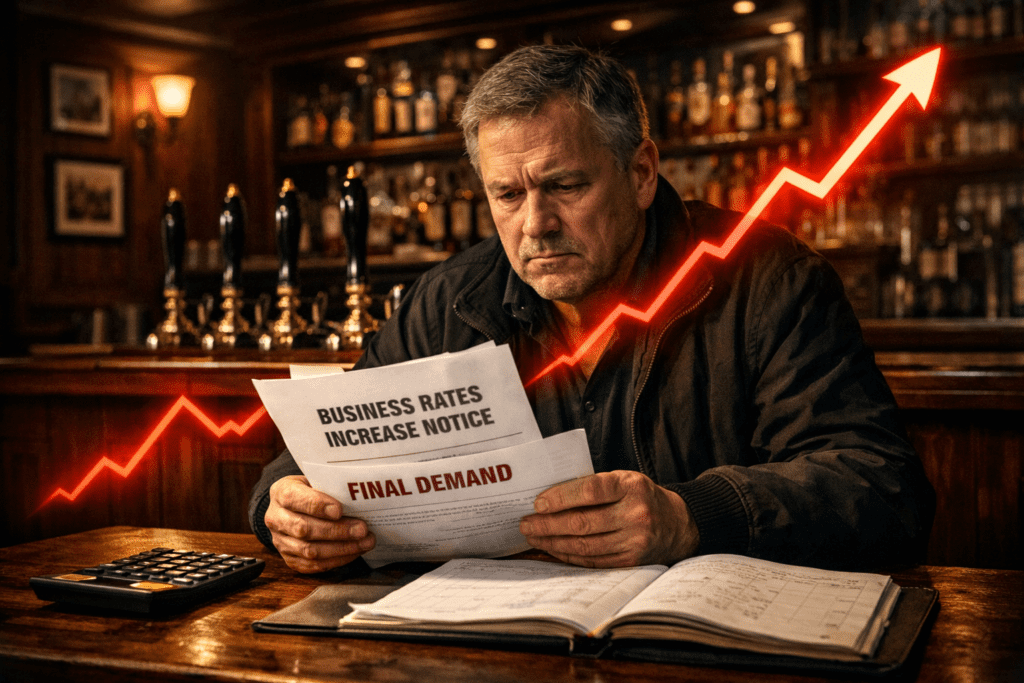
Recent reporting in the Financial Times has highlighted growing pressure within the UK pub sector, as operators call on the government for urgent financial support in response to sharply rising business rates and operating costs. While hospitality is once again under the spotlight, the underlying issues raised should resonate far beyond pubs alone.
According to the FT, much of the strain stems from increases in rateable values – the estimates used to calculate business rates – which have risen significantly since the last pandemic-era valuation. In some cases, values have reportedly doubled or trebled, with more typical increases of around 30 per cent. At the same time, Covid-era reliefs that previously reduced rates bills by up to 40 per cent are being withdrawn, compounding the impact on cash flow.
In response, the government has pointed to transitional relief and potential licensing reforms as ways to soften the blow. However, industry leaders quoted by the Financial Times have been clear that these measures do little to address the real issue.
Several senior figures in the sector have publicly dismissed licensing flexibility, such as extended opening hours or relaxed rules, as ineffective in the face of rising fixed costs. As one operator noted in the FT, many hospitality businesses are actually reducing trading hours to remain viable, not extending them. Operating longer often increases staffing, energy and compliance costs without guaranteeing additional revenue.
This is an important point for directors across all sectors: more activity does not automatically mean more profitability.
A broader warning for UK directors
While the headlines focus on pubs, the dynamics at play are increasingly common across UK businesses. Directors are grappling with:
- rising fixed costs that are largely outside their control
- limited ability to pass those costs on to customers
- narrowing margins that leave little room for error
What the FT coverage illustrates particularly well is how quickly external pressures, such as tax changes or valuation uplifts, can push otherwise viable businesses into difficult territory.
For directors planning for 2026, the lesson is not about waiting for policy changes or economic improvement. It’s about understanding exposure early and responding with clarity rather than optimism alone.
Negative headlines are inevitable. As the FT reporting shows, mainstream media will continue to focus on sectors under strain and on political responses to those pressures. That is their role.
What matters for directors is not the volume of commentary, but how well they understand their own position:
- how long current cash reserves realistically last
- what pressure points emerge over the next six to twelve months
- and what options exist if trading conditions remain tight
Too often, directors delay seeking clarity because they fear what they might hear. In practice, the opposite is usually true: information restores control.
A constructive step directors can take now
If you already sense that cash flow is tightening, that early 2026 looks less comfortable, or that external cost pressures are starting to outweigh operational improvements, one of the most positive actions available costs nothing.
A free initial case review and consultation allows directors to talk openly through their situation, without obligation. From there, a tailored overview of realistic options, timescales, outcomes and costs can be provided, giving you the information needed to make decisions on your own terms.
In an environment where headlines often feel relentlessly negative, regaining clarity and control is, in itself, a genuinely positive outcome.